



Emilio Ambasz’s masterpiece celebrates its 50th anniversary in 2025: a pioneering work that blends architecture, landscape, and introspection, anticipating themes of sustainability and the quest for a “spiritual dwelling”
In 2025, the Casa de Retiro Espiritual in Seville marks the 50th anniversary of one of Emilio Ambasz’s most iconic projects. Considered one of the most celebrated architectural visions in the world, this house is, in Ambasz’s own words, “not a building, but a thought.” A place where “silence has an architecture and the landscape a voice,” capable of bringing the idea of home back to its primordial dimension.
Designed in 1975, the work emerged from the mind of a young Argentine architect who was already a key figure in the international discourse. Ambasz, who graduated from Princeton University in record time, had captured global attention three years earlier by curating the historic MoMA exhibition Italy: The New Domestic Landscape, which brought Italian design into the international spotlight.
A Radical Vision in 1970s Architecture
The project immediately received the prestigious Progressive Architecture Award, a recognition that affirmed its innovative strength. Far from the dystopias envisioned by groups like Superstudio or Archizoom, Ambasz imagined a house seeking redemption in the earth, merging monumentality and intimacy.
The Casa de Retiro Espiritual would instantly establish itself as both a manifesto and a complete work: enigmatic, symbolic, almost initiatory. A project many have described as a “Rosetta Stone” capable of decoding Ambasz’s poetics and his approach to the relationship between architecture and territory.
An Aesthetic Suspended Between Myth and Landscape
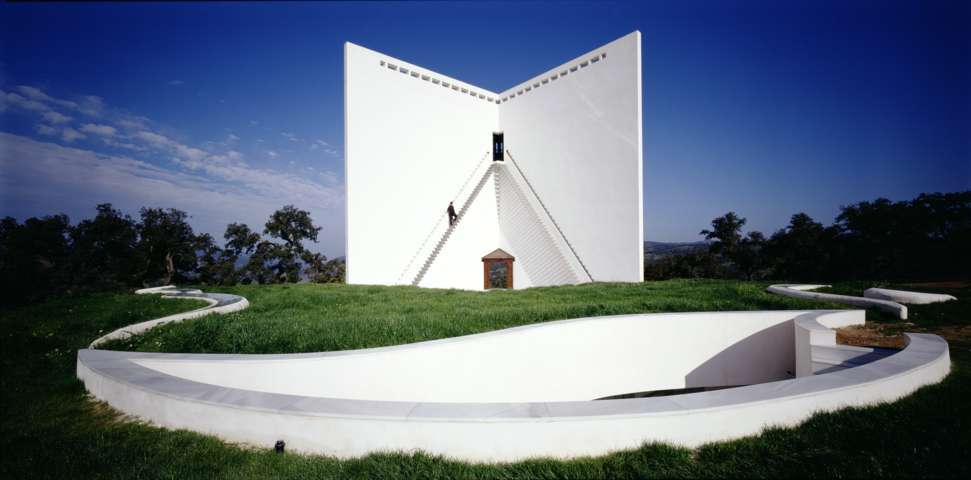
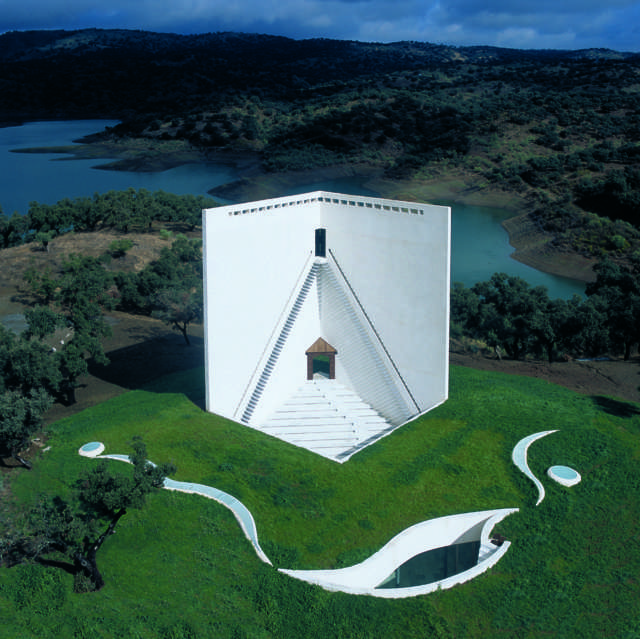
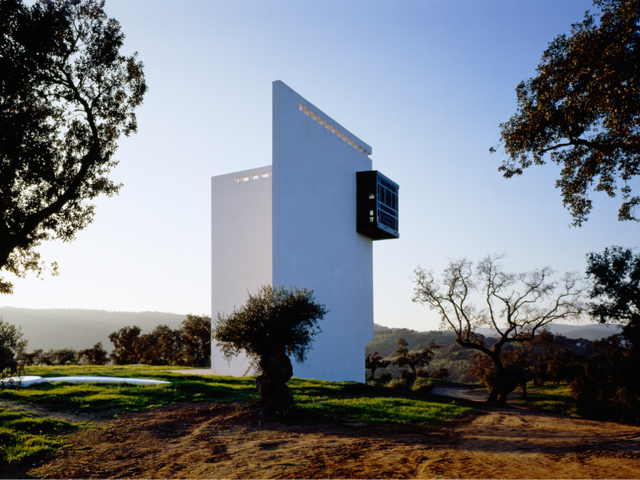
The exterior is defined by two enormous white walls that meet at a right angle. The structure has no roof; instead, a suspended belvedere opens onto the 600 hectares of greenery in the Sierra Morena.
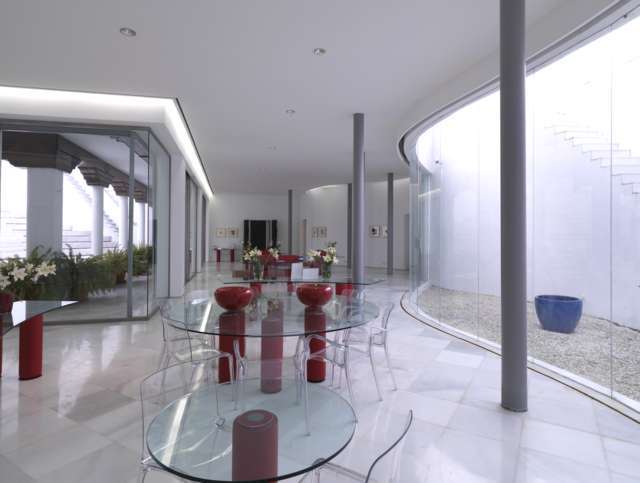
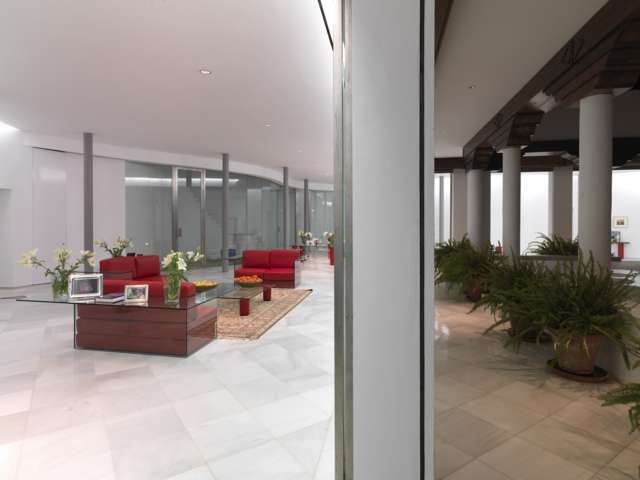
The walls, opened like a book, are traversed by twin staircases that seem to skim the void. Along their serpentine outline runs a handrail-channel that guides water from the upper spring down to the subterranean patio. The architecture disappears into the earth: the main rooms face a protected courtyard illuminated by skylights that modulate natural light with shifting effects.
A house “with walls but no inside,” as many critics have observed, where spaces appear to oscillate between presence and absence, matter and imagination.
A Pioneering Architecture of Sustainability
According to Barry Bergdoll, Meyer Schapiro Professor of Art History and Archaeology at Columbia University, the house represents one of the earliest insights into using vegetation and earth as insulation strategies—an approach considered fundamental today in sustainability discourse, yet remarkably ahead of its time.
Ambasz layers the building into the terrain through cuts and embankments that blend technical rigor with the poetry of the landscape: a method of building that responds to the southern Spanish climate while fulfilling the desire to create a spiritual refuge.
A Ritual House, Beyond Space and Function
The Casa de Retiro Espiritual operates at the margins: between built form and nature, between the visible and the interior, between matter and myth. A work that does not merely define a habitable space but proposes architecture as ritual, as a form capable of gathering emotions and universality.
For Ambasz, every project is a set of rituals, a search for a “dwelling of the soul.”
“An architect can be the guardian of the desert of cities created by man, or the magician who creates eternal forms,” he says. And he adds: “If an architectural work does not touch the heart, it is just another building.”